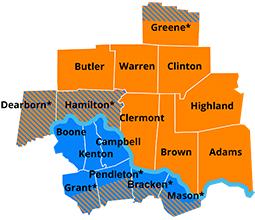
Clermont County blends fast-growing suburban corridors with creek-valley and lake-country lots, so build planning starts with jurisdiction and site conditions. Many residential permits and inspections route through Permit Central in Batavia, and projects on private septic commonly require Public Health District review in parallel. If your lot is in a city/village or in a township with its own zoning process (notably the higher-growth western side), confirm which authority governs setbacks, accessory structures, and driveway standards before finalizing a footprint.
Access and right-of-way work is a frequent trigger for extra steps in Clermont. New driveways, culverts, roadside drainage changes, or utility work in the public right-of-way often require coordination with the County Engineer (or the local jurisdiction), so it’s wise to align your driveway location early—especially on higher-speed roads and along SR 32 connectors.
Topography varies from gentler uplands in developed western areas to more dissected creek valleys as you move east and south. That variation impacts grading cost, walkout feasibility, stormwater routing, and whether you can realistically support a basement without extensive drainage measures. Floodplain screening is particularly important near the Little Miami River system and around the East Fork / William H. Harsha Lake watershed, where low areas and tributary bottoms can constrain elevations and foundation choices.
Utilities are highly location-dependent: established corridors near Eastgate/I-275 and Batavia/SR 32 are more likely to have public water and sewer, while outlying lots may need well + onsite wastewater. Well yields can vary with local geology, so plan for a practical well location and consider early test information when available.
Ready to explore building here? Use our contact form to tell us about your land, preferred plan, and timeline, and we’ll follow up with the next practical steps.